Registration, Experience, and Real-World Fit
Choosing a solemniser is one of the most important legal decisions you will make when planning a wedding in Ireland — yet it is often treated as an afterthought.
If you’re still getting your bearings on how the legal process fits together overall, this overview may help → Getting Married in Ireland: How the Legal Process Actually Works
Many couples assume that once someone is “registered,” all solemnisers offer the same thing.
Legally, registration is essential. Practically, it is only the starting point.
This page explains what registration actually guarantees, what it does not, and how to choose a solemniser whose experience, scope, and approach genuinely fit you as a couple.
Registration: The Legal Baseline
Every legal marriage in Ireland must be solemnised by a person who is entered on the State’s Register of Solemnisers. Registration confirms that the person is legally authorised to:
Conduct a legally binding marriage
Oversee the Marriage Registration Form (MRF)
Ensure the required legal declarations are made
Confirm witnesses and venue suitability
Without registration, a ceremony — no matter how meaningful — does not create a legal marriage.
This distinction is explained in more detail here → Who Can Legally Marry You in Ireland (and Who Can’t)
Registration is therefore non-negotiable. But it is not the whole picture.
Experience: Time on the Register Matters
One of the most overlooked indicators of experience is how long a solemniser has been registered.
The Register of Solemnisers records the date each solemniser was first entered onto the register.
You can learn how to read the register — and what that date actually tells you — here → How Experienced Is Your Solemniser? (Understanding the Register of Solemnisers)
That date often reflects:
Familiarity with the notice process
Experience handling last-minute issues
Confidence managing legal requirements calmly on the day
Understanding of how law, venues, and ceremonies interact in practice
Two solemnisers may both be registered — but one may have been conducting legal marriages for years, while another may be newly registered. That difference is not a criticism; it is simply a fact worth understanding.
Registration Does Not Mean Unlimited Scope
All registered solemnisers have legal authority.
They do not all have the same scope of practice.
Many solemnisers are aligned to religious bodies whose doctrine places limits on:
Where ceremonies may take place
Who may be married
The structure or content of the ceremony
These limits are not imposed by Irish law. They arise from the rules of the nominating religious body.
This is also where venue misunderstandings often arise → Wedding Venues and Legal Marriage in Ireland: What Actually Matters (and What Doesn’t)
For couples whose beliefs align with those traditions, this can be deeply meaningful. For others, it can feel unexpectedly restrictive — especially if assumptions are made early and clarified late.
Open-Framework and Interfaith Solemnisers
Some registered solemnisers are aligned to religious bodies whose doctrine is intentionally inclusive rather than prescriptive. These bodies recognise that couples may come from different faiths, from no faith, or from blended belief backgrounds.
In practical terms, solemnisers aligned with such bodies often have scope to:
Marry couples of any or no faith
Work with mixed-belief families
Conduct ceremonies in a wide range of legally suitable venues
Create ceremonies that are personal without being symbolic-only
This flexibility does not come from weaker regulation.
It comes from the nature of the religious framework itself, which Irish law explicitly recognises.
Civil Registrars: Clear, Reliable, and Structured
Civil registrars are State employees who conduct civil ceremonies only. These ceremonies:
Take place in registry offices or HSE-approved venues
Follow a defined civil structure
Are legally clear and administratively consistent
They offer certainty and simplicity, but with limited flexibility in content and location.
For some couples, this is exactly what they want. For others, it is important to understand these limits before committing.
If you’re weighing civil versus solemniser-led ceremonies, venue flexibility is often a deciding factor → The Venue Checklist: Questions to Ask Before You Book
A Note on Different Approaches
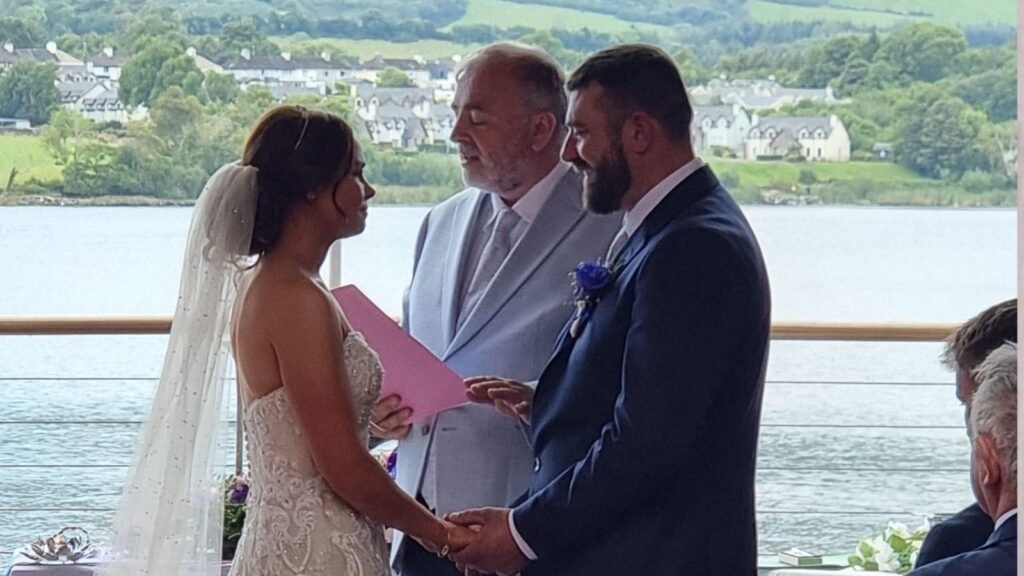
In my own case, I am a registered solemniser aligned to an interfaith religious body, which allows me to work with couples from all backgrounds — religious, mixed-belief, or non-religious. That framework means the legal requirements are handled with care and clarity, while the ceremony itself can be shaped around the couple, their families, and what matters to them, rather than imposing my beliefs on them. For many couples, that balance is what makes the process feel calm rather than complicated.
The Questions That Actually Matter
Instead of focusing on titles or labels, ask practical questions early:
Are there any doctrinal or organisational limits on who you marry?
Are there limits on venue type or ceremony structure?
How long have you been registered as a solemniser?
How do you handle the legal process on the day?
Clear answers here prevent misunderstandings later.
Many of these questions connect directly to notice timelines and ceremony structure →
The 3-Month Notice Period Explained (Why It Catches So Many Couples Out)
What Actually Happens on the Wedding Day (Legally Speaking)
Bringing It Together
Choosing a solemniser is not about finding “the best” in abstract terms. It is about finding the right fit — legally, practically, and personally.
Registration confirms legal authority.
Experience shows depth.
Scope determines freedom.
When those three align with who you are as a couple, the legal process becomes quiet, calm, and supportive — leaving your ceremony free to be what it should be: meaningful, grounded, and genuinely yours.
For couples concerned about how the ceremony will actually feel on the day → What Your Wedding Ceremony Can Feel Like (and How to Shape It)
This article touches on themes explored more fully in my writing on ceremony and marriage, where the legal, practical, and human aspects of marriage are examined together.